
In the demanding environment of a precast concrete plant, internal logistics often dictate the overall profit margin. Modern production requires seamless integration between the mixing plant and the casting beds. Implementing an automated Concrete delivery system is the most effective way to eliminate downtime, remove human error, and ensure that high-speed extruders or slipformers operate at peak capacity.
System Mechanics and Operational Logic
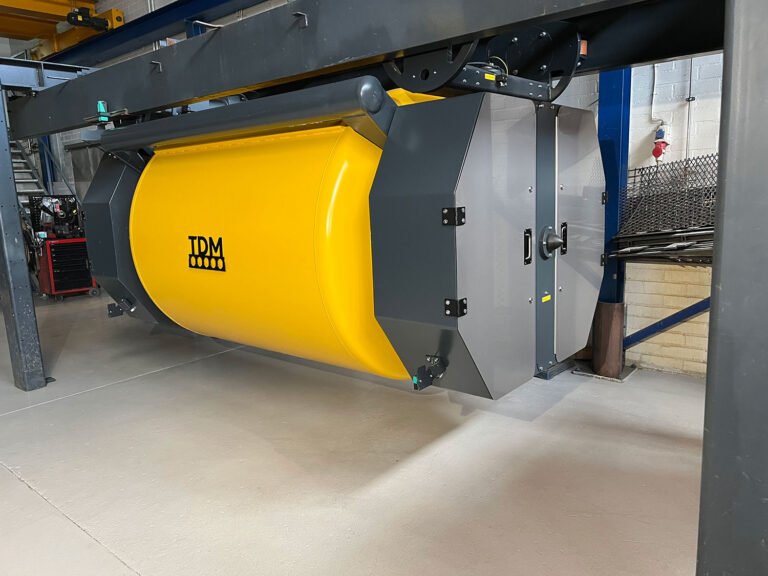
The core of the technology is an automated shuttle (flying bucket) that travels along a dedicated rail track. Unlike primitive manual carts or slow overhead cranes, this specialized Concrete delivery system integrates directly into the plant’s master control unit. The shuttle automatically requests a batch from the batching plant as soon as sensors detect low material levels in the extruder’s receiving hopper.
The engineering allows the system to navigate complex layouts, including curves, inclines, and declines. This is a critical advantage for established factories with tight spatial constraints where a straight-line path isn't feasible. Inverter-controlled motors (ranging from 6 to 12 kW) ensure smooth acceleration and braking, preventing mix segregation and reducing mechanical wear on the rail infrastructure.
Application in Prestressed Concrete Production
The Concrete delivery system plays a vital role in long-line production cycles. The typical workflow in a high-efficiency plant follows these steps:
1. Preparation: High-tensile wires or strands are positioned on the casting beds and tensioned using professional PAUL hydraulic jacks.
2. Delivery Cycle: While the operator prepares the casting machine, the shuttle delivers 1.5–2.0 $m^3$ of compacted concrete to the work zone.
3. Casting: By utilizing an intermediate buffer hopper equipped with vibrators, the mix is fed into the extruder continuously. This ensures a uniform density across the entire slab and prevents structural defects caused by pauses in the casting process.
Technical Advantages of TDM and PAUL Solutions
Investing in a professional Concrete delivery system provides measurable industrial benefits:
- Elimination of Human Factor: Automation ensures the right mix reaches the right machine on time, every time, stabilizing the production rhythm.
- Resource Efficiency: The system operates on minimal power (6–12 kW) and replaces at least one forklift and its dedicated operator, significantly lowering overhead.
- Handling Low-Slump Mixes: The specific geometry of the bucket and integrated vibration units are designed to discharge zero-slump concrete ($S1$, $S2$) effectively.
- High Maneuverability: Polyurethane wheels on dual-rail tracks allow for fast, near-silent movement even in confined plant environments.
Results and Commercial Value
A reliable Concrete delivery system is your guarantee that the extruder never sits idle while the casting beds are ready. Combined with PAUL tensioning equipment, you achieve a closed-loop production cycle with the lowest possible cost per square meter.
TDM Engineering provides turnkey solutions: from custom rail path engineering to the final commissioning of control systems. If your goal is to increase output without expanding your workforce, automating your concrete delivery is the essential next step. Contact us for a detailed technical proposal tailored to your plant’s specific layout and capacity.
